
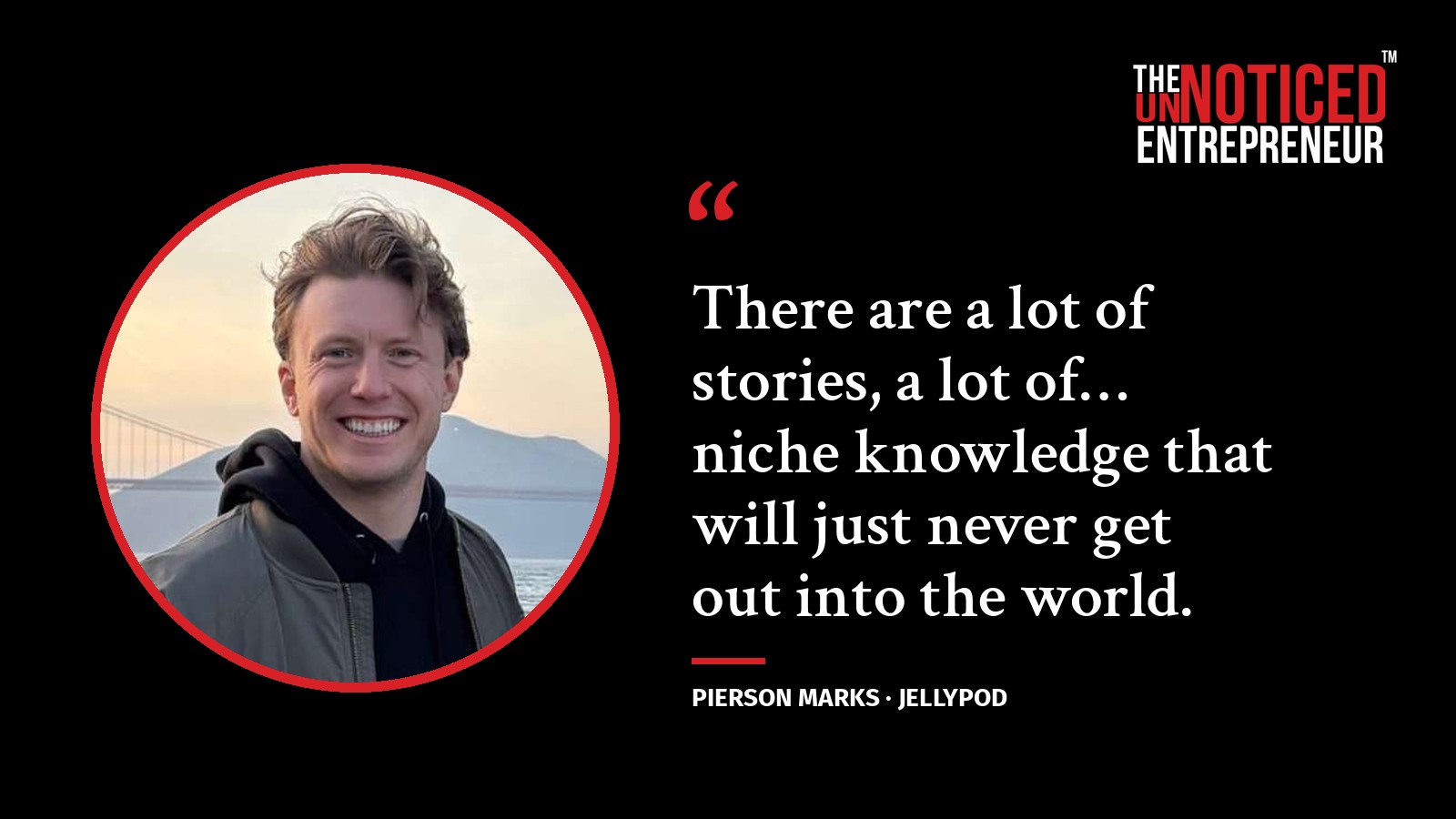
From The UnNoticed Entrepreneur archive: Jim James talks to Pierson Marks, co-founder of JellyPod, in San Francisco. Published 2026. Disclosure: Jim uses JellyPod for his own podcasts, and the JellyPod link in this article is an affiliate link, so we may earn a commission if you sign up.
In two minutes
- JellyPod turns documents, links or a simple prompt into a podcast with AI voices, including a clone of your own.
- It isn’t trying to replace human podcasts. It serves people who would never record one: professors, specialists, busy experts.
- A two-person team says it has reached more than 75,000 users and 100,000 podcasts, with AI agents writing much of the code.
Jim opened with a challenge. He cited research by Edison suggesting that voice is the least popular use of AI in podcasting: listeners don’t mind AI show notes or thumbnails, but they object to AI voices. So why build a business on them?
It’s about quality, not who made it
Pierson’s answer is that people react to feeling deceived, and to low-quality “slop”, not to synthetic audio as such. People listen to and watch plenty that was never a person, from Mickey Mouse to Toy Story. If it’s engaging and not a waste of time, Pierson argues, most listeners don’t care how it was produced. A bad podcast is bad whether a human or a machine made it.
And JellyPod mostly isn’t competing with long-form human shows anyway. “There are a lot of stories, a lot of… niche knowledge that will just never get out into the world” because the expert won’t, or can’t, get behind a microphone.
Two use cases
- The professor. Steve DeNunzio, a professor of logistics at Ohio State University, produces a regular ten-minute news podcast for his MBA students. He uses a clone of his own voice alongside an AI co-host, Ellie. Pierson says the students love the characters.
- The specialist. Noel Bradford, the “small business cybersecurity guy” in the UK, has decades of expertise but would never have spent the time in a studio. Pierson says his show now reaches around 100,000 listeners a month.
Jim’s own use case: a local Wiltshire news podcast with his own cloned voice and an AI co-host, because local councillors and chamber members never had time to come into a studio.
How it works
Pierson describes three steps, with a target of your first episode live within 20 minutes:
- Create your hosts: a name, a backstory and a voice (a clone of yours or one from the library).
- Create your series: what the podcast is about.
- Create an episode: drop in documents, links or a prompt, review the script it writes, then generate the audio.
The idea is to get you 80% to 90% of the way quickly, with you as editor in chief. JellyPod can now research a topic itself from a prompt, and automations can produce an episode on a schedule, say every morning at 9am, either publishing automatically or saving a draft for you to check. It includes hosting and an RSS feed to Spotify and Apple; YouTube still needs a manual download and upload.
The voices come from specialist labs such as ElevenLabs and Google’s Gemini models. JellyPod doesn’t train its own; it focuses on the podcasting workflow.
The pivot and the price
JellyPod started in 2023 as a mobile app that turned each user’s email newsletters into a personal daily podcast. It was too early and too expensive: one episode served one listener. The pivot to a studio flipped the economics, because one creator’s episode can serve a whole audience.
Pricing is by credits, where one credit is one second of audio. The starter plan, at $30 a month when we spoke, gives 5,000 credits, enough for about eight ten-minute episodes.
Two people, a hundred people’s work
Pierson worked on Amazon’s Alexa team before founding JellyPod; his co-founder Bilal joined about a year before we spoke, after they met through the AI Tinkerers engineering community. Pierson says AI coding agents now let one person do work that once needed far more, provided you’re clear about what you want. “If you don’t, then it’ll go off the rails,” just like briefing an employee badly.
His advice to founders: AI replaces tasks rather than whole jobs, and the problems that recently looked too hard or too expensive may now be the best ones for a small team to tackle.
The business model: JellyPod
- Customer: experts, educators and businesses who want a podcast but won’t or can’t record one.
- Problem it solves: the time, cost and confidence barriers to producing audio.
- How it makes money: monthly subscriptions with audio credits.
- Pricing: from $30 a month for 5,000 credits (about 83 minutes of audio) at the time of recording.
- How it wins customers: case studies, a free trial and the founders’ weekly live streams.
- Role of AI: the core product, built largely with AI coding agents.
- The pattern: a workflow layer on top of other companies’ AI models, priced so one creator can serve many listeners.
Lessons you can use
- Serve the people who’d never do it the old way. New technology often creates a market instead of stealing one.
- Watch your unit economics. JellyPod’s first idea served one person per episode; the pivot served thousands.
- Build on the giants. Let the big labs train the models; win on workflow.
- Keep a human in the loop. Drafts you can edit protect quality and trust.
- Be honest about AI voices. Listeners object to being deceived, so say when a voice is synthetic.
Try this this week
- List the expertise in your business that never gets shared because nobody has time to record it.
- Take one article or report you’ve written and turn it into a ten-minute audio version with an AI tool. Label it as AI voiced.
- Write a clear brief for one AI task, as you would for a new employee, and compare the result with a one-line request.
JellyPod: Try JellyPod free (affiliate link) | Pierson Marks: piersonmarks.com
Listen to the full episode
Open the episode page · Get the next interview in your inbox



Leave a Reply