
From The UnNoticed Entrepreneur archive: Jim James talks to Damion Lupo, co-founder and chief investment officer of FrameTec, in Sedona, Arizona. Published July 2025. Figures quoted are as Damion described them.
In two minutes
- FrameTec turns stacks of lumber into one “infinite board”, cut to exact lengths in a factory. Damion says a house can be framed in a day instead of four to seven.
- All of the money raised (over $100 million, by his account) came from individuals who already trusted the team, not institutions.
- His rule for any founder: get the “foundational 15%” right before you start, and hire the best people, because cheap people cost you more.
Listen to the episode
Damion Lupo has built more than 70 companies and lost $25 million in 2008. FrameTec, he says, is what 30 years of wins and failures prepared him for.
The problem: a 71-year-old method
Damion puts the US housing shortage at roughly 10 million homes, and says the market goes backwards every year. Framing, the skeleton of a house, hasn’t really changed since the nail gun, about 71 years ago. Fix framing, he argues, and the rest of the build can follow.
The innovation
The idea came from Marvin, a framer since the 1970s, who carried it around for 20 years until it found a team and money. In FrameTec’s patented process:
- Boards are scanned and the defects cut out.
- The good pieces are finger-jointed into one continuous board.
- That board is cut to the exact length needed for trusses and walls.
The result is precise components with very little waste. Panels are assembled on site in a day. Damion compares it with building a car in your front yard versus on a production line.
How they raised the money
The first plant needed about $40 million. Roughly $15 million went on the building alone, and the robots and equipment added up fast. Adding more automation along the way cut the planned labour force by about 30%.
None of the money was institutional. “Main Street, not Wall Street,” Damion says. It came from people who had known and trusted the team for years. His point is that people invest in people, and there is no hack for that: you build trust by serving and giving long before you ask.
Doing one thing well
FrameTec sells direct to developers, with no brokers in the middle. It deliberately doesn’t do emergency or modular homes; other companies do that. “Know who you are, what you do and who you serve,” Damion says. More plants are planned in Arizona and Texas, and licensing the patented process to others is an option.
Lessons from 70 companies
- Don’t wait for the perfect business. Every venture, including the failures, taught him something FrameTec needed.
- Get failure out of your head. After 2008 he wrote down every lesson, and later turned them into books. Writing it down stops the rumination.
- Playing safe has a cost. His father played not to lose and regretted it. “We’re not going to regret what we did. We’re going to regret what we didn’t do.”
- The foundational 15%. In his book Unicornomics, Damion argues that a few basics (enough capital, the right team, a clear mission) give you an 85% chance of success. Running out of money, he says, means making decisions in panic.
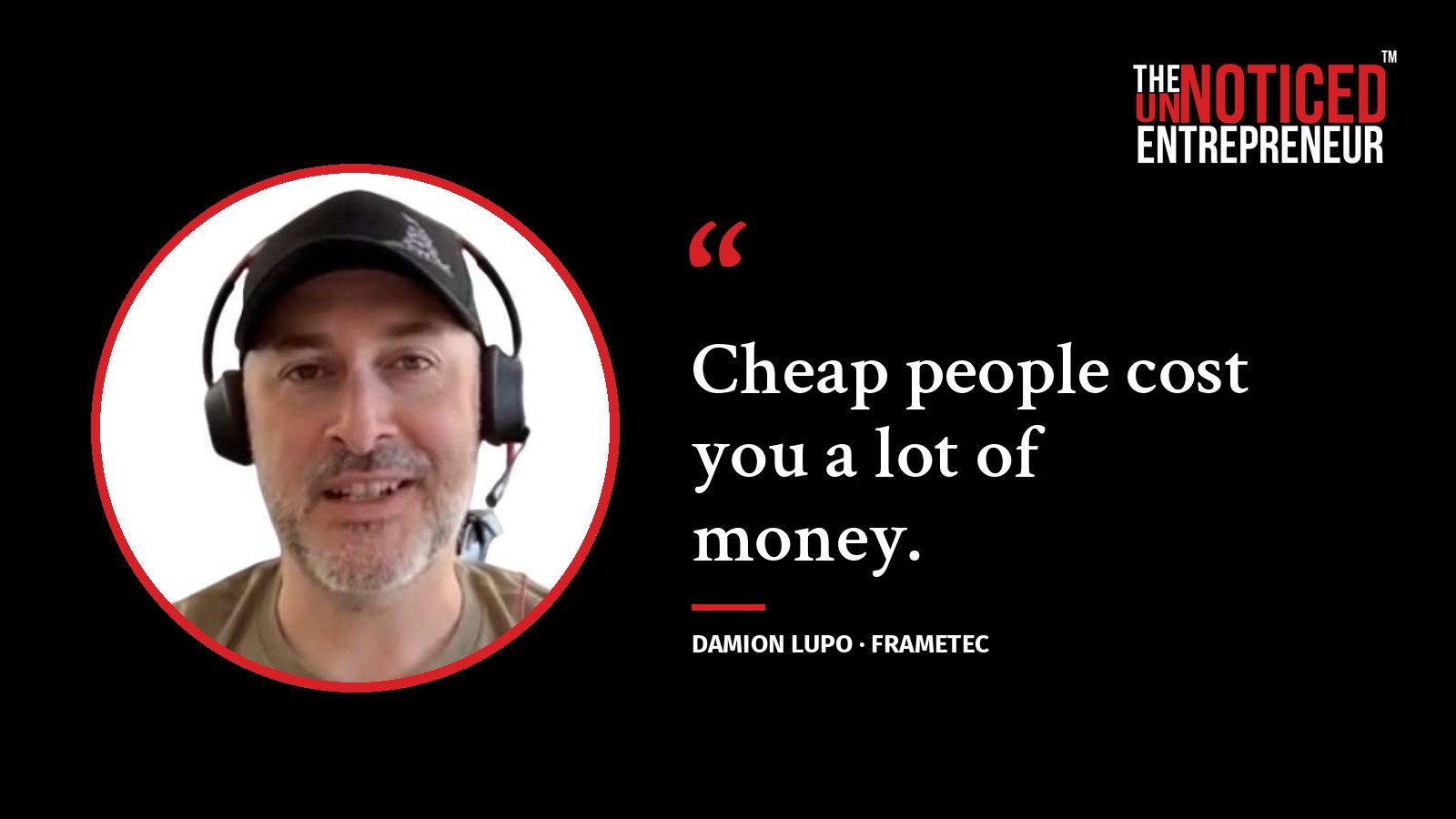
- Hire the best. Doing everything himself and hiring the cheapest people were among his worst mistakes. “Cheap people cost you a lot of money.”
The business model: FrameTec
- Customer: home builders and developers within roughly 100–200 miles of each plant.
- Problem it solves: slow, wasteful, labour-hungry framing during a housing shortage.
- How it makes money: factory-made framing components, sold direct and installed on site; licensing the patented technology is an option.
- How it wins customers: proof. Houses built side by side, shared on LinkedIn, showing the difference.
- Role of AI and automation: robotics in the plant, which reduced planned headcount by about 30%.
- The pattern: move a site-built craft into a factory, then sell the speed and precision.
Lessons you can use
- Every industry can be re-engineered. Ask “can we do this better?” and then “should we?”
- Your network is capital. Relationships built over decades can fund a venture faster than a pitch deck.
- Show, don’t claim. FrameTec won sceptics by delivering and posting the results.
- Choose your niche on purpose. Saying no keeps you efficient.
- Pay for quality people. They make you money.
Try this this week
- Write down the three biggest lessons from your last setback, and what you’d do differently.
- List the people who already trust you. Who could back your next idea?
- Pick one thing your business “can” do but shouldn’t, and stop offering it.
Damion Lupo: find him on LinkedIn. His book is Unicornomics (unicornomics.net) and his podcast is Financial Underdogs.



Leave a Reply