
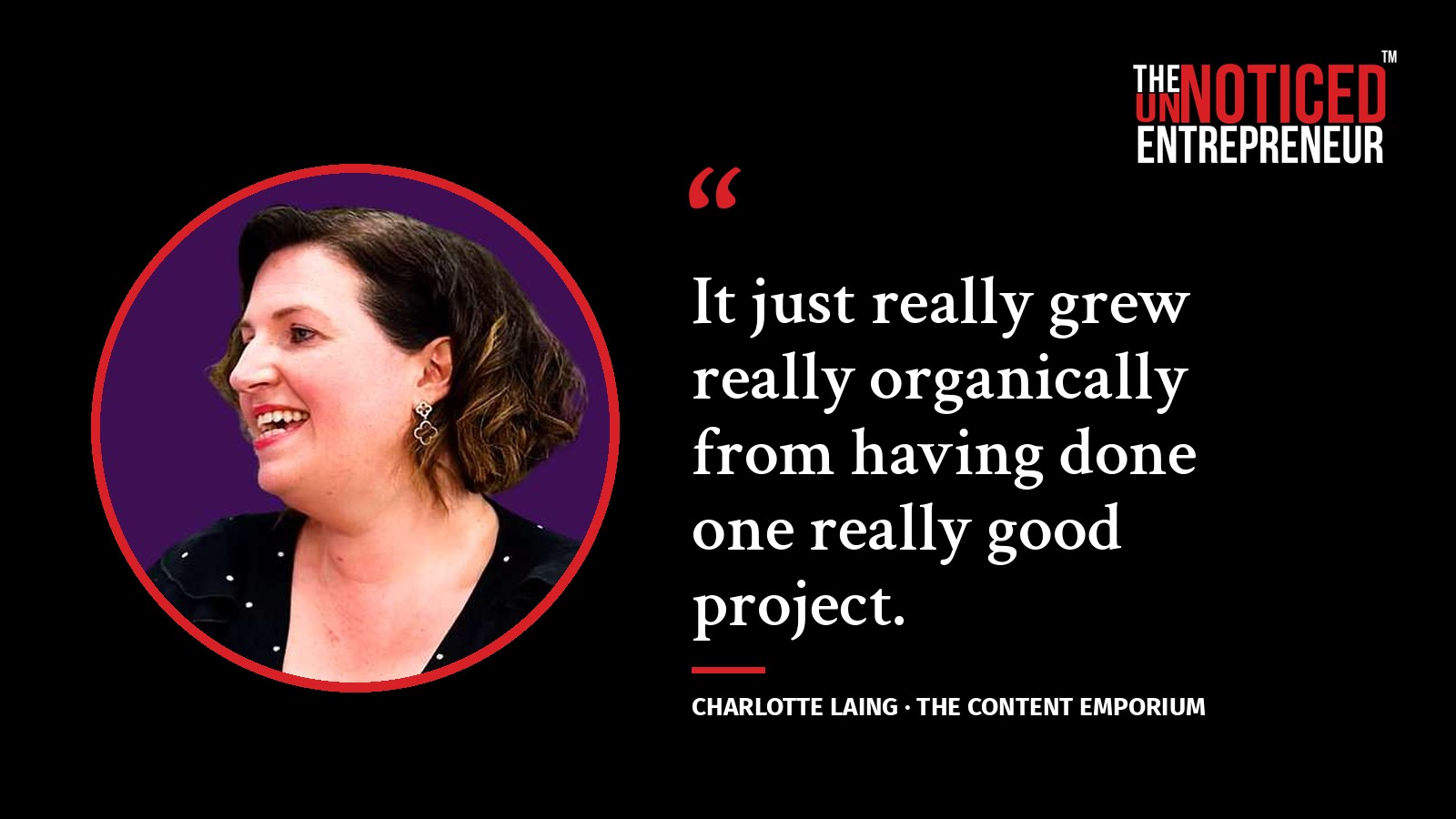
From The UnNoticed Entrepreneur archive: Jim James talks to Charlotte Laing, founder of The Content Emporium in Bristol. Published 2025. Disclosure: this episode was part of a series sponsored by NatWest Accelerator, a programme Charlotte took part in. The views are hers and Jim’s, not NatWest’s.
In two minutes
- A magazine editor who felt she was giving too much to her job turned one shopping-centre magazine into an agency of about 53 people serving centres across the UK.
- Her breakthrough past the £1 million mark came from pricing on value, not cost, and having a frank conversation with her biggest client.
- Her rules for cash flow: long contracts, invoice core work in advance, and ask for better terms if you’re valuable.
One good project, then word of mouth
Charlotte was editing a glossy women’s magazine for Media Wales in Cardiff. She realised she was overworking and “creating something really good” for an employer, and decided to get paid for the extra mile herself.
Shopping centres suited her skills: fashion, beauty, food and drink, with human-interest stories inside every centre. Winning the first one took persistence: an email, another email, then a phone call. That magazine went so well the centre asked her to run its website, then its email and social media. Other centres saw the work and wanted the same. Today the clients run from Bluewater in Kent to St David’s in Cardiff and Buchanan Galleries in Glasgow.
What she brought was an editorial sensibility, not a marketing one. Instead of going straight for the sale, the agency weaves a lifestyle story around a visit. Since Covid, she says, they aren’t selling the shirt, which people can buy online; they’re selling the experience of going in, buying it and staying for a meal.
The first hire
She formed a limited company and made her first hire around 2015. At 34 she was planning a baby and faced a choice: close the fledgling business or hire someone to keep it going. That hire, another Charlotte (“Char”), is now her chief operations officer.
Charlotte kept no “iron curtain” between herself and her first employee. She shared how much money was coming in, what needed winning and whether to hire a third person.
Breaking through £1 million
Around £1 million turnover, Charlotte says, you can still know everyone and keep track of every project. Beyond it you need managers, strategy, finance and HR, and her rates only just covered the people doing the work.
Her mentor on the NatWest Accelerator asked why she thought of herself as a cost to her client rather than the value she added. She went to her biggest client and explained what a larger agency could offer: strategy, better invoicing, senior single points of contact. The result was a better contract and more work. Through her mentor she also met NatWest’s procurement team, who explained that large buyers’ intrusive questions are simply about making sure a supplier can deliver.
Bigger clients also expect you to look like a serious agency: how you present reports and documents, and strong senior contacts for each area.
Cash flow without equity
There were tight months, waiting for an invoice to land before payroll and checking whether her mum could help if it didn’t. Now the agency has long contracts and invoices core work ahead of delivery, leaving only ad hoc projects and profit to be billed afterwards. Her advice: if you’re valuable to a client, ask for better payment terms. Large clients care about reliability, not 30 days here or there.
Beating the big agencies
Big networks have occasionally taken roles with her clients, and in her experience it hasn’t worked. They pitch big strategy, then delivery is slow, and Jim recalled the “pitch and switch”, where seniors win the account and juniors run it. Charlotte’s team works with clients daily, and the people doing the work are the people clients talk to.
She keeps quality high by being “quietly quite demanding” and hiring senior people who care as much as she does. Systems include Trello for workflow, Sprout Social for social media management, and Synergist agency-management software, which they were adopting when we spoke.
AI and human content
The agency’s best content features people, such as centre staff and shoppers, and Charlotte doesn’t see AI replacing that soon. Testing AI captions produced copy that felt generic and that the public would be suspicious of. But they use AI creatively: when the “AI doll in a box” trend took off, they made a boxed version of Hev, a much-loved Bluewater employee, complete with a Greggs pasty. It was popular, and “just as much work” as their other content.
Her advice for small businesses: make content that’s relatable, avoid text-on-graphic posts outside LinkedIn, keep a consistent look and tone, and set aside time every week to actually make it.
What’s next
A seven-strong leadership team aims for around £10 million turnover within two years, mapped out with backcasting, a method she learned on the accelerator: picture the whole company at the end point, then work back to what must happen in two years, one year, and the next few weeks. That includes hiring roles such as a finance director before you need them. Business development, long left to word of mouth, is now a focus.
The accelerator also eased the loneliness of carrying the finances, clients and staff wages. Being open, with her mentor, other founders and her team, has helped her mental health.
The business model: The Content Emporium
- Customer: large shopping centres and big brands across the UK.
- Problem it solves: in-house teams lack the range of skills now needed across social, web, CRM and design.
- How it makes money: long-term content and marketing contracts, with core work invoiced in advance.
- Pricing: not disclosed; reset on value after her rates only covered delivery staff.
- How it wins customers: outstanding work and word of mouth between centres; business development now a focus.
- Role of AI: a creative tool, not a replacement for people-led content.
- The pattern: one great project for a client, then expand across their channels and their peers.
Lessons you can use
- Do one thing brilliantly. Charlotte’s whole agency grew from one magazine.
- Price on value. If your rates only cover delivery, you can’t build management, strategy or finance.
- Look the part. Big clients judge how you present as well as what you deliver.
- Fix cash flow in the contract. Invoice fixed costs in advance and ask for terms you need.
- Hire ahead of growth. Backcast from your goal and put roles and systems in early.
- Don’t carry it alone. A mentor or peer group makes the weight lighter.
Try this this week
- Calculate whether your current prices cover management, finance and strategy, not just delivery.
- Draft the conversation you’d have with your biggest client about value or payment terms.
- Try backcasting: write down where you want the business to be in three years, then what must be true in one year and in one month.
Listen to the full episode
Open the episode page · Get the next interview in your inbox



Leave a Reply