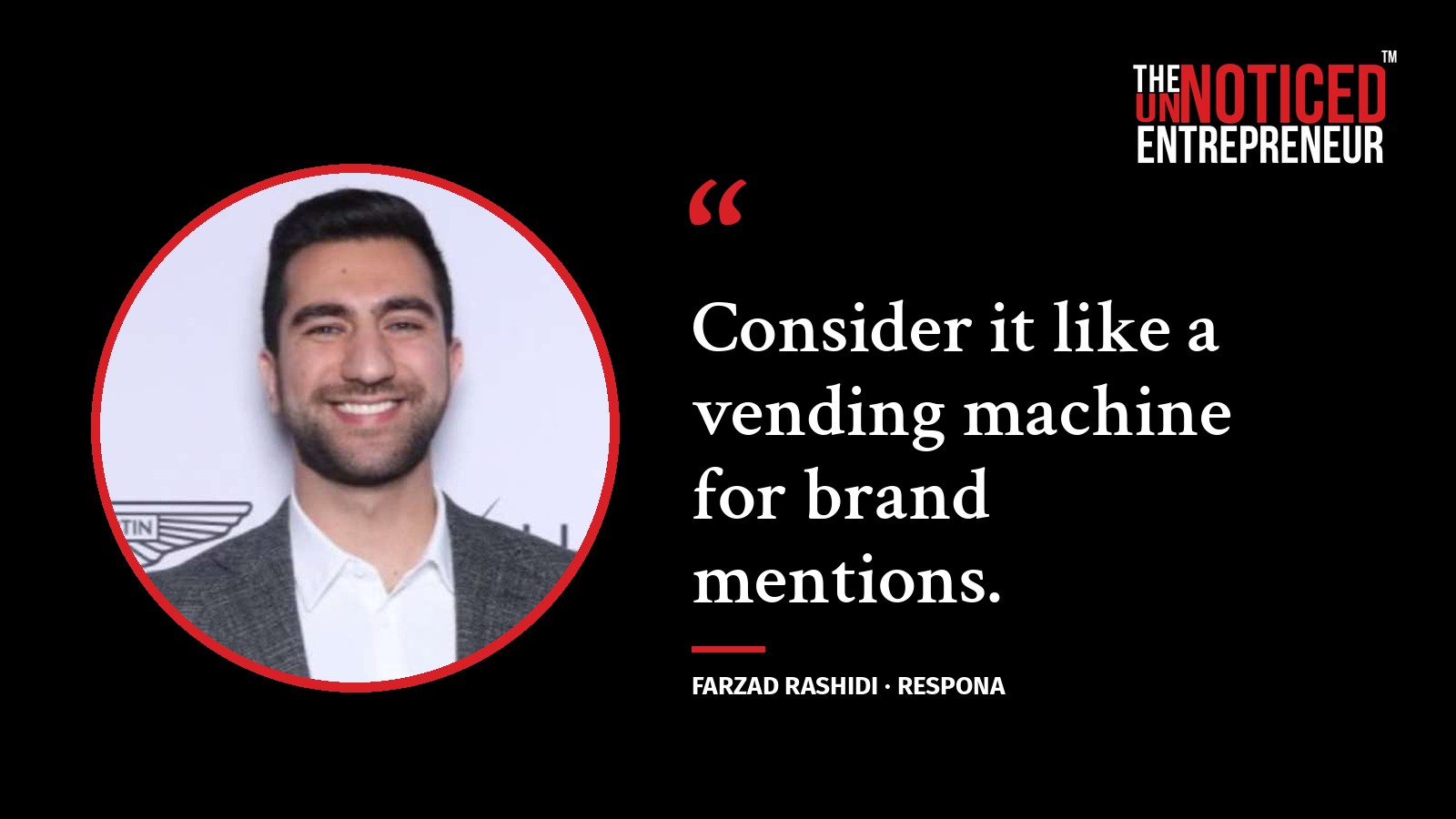
From The UnNoticed Entrepreneur archive: Jim James talks to Farzad Rashidi of Respona, in Washington DC. Published 2026. Disclosure: Farzad previously gave Jim free access to Respona’s software.
In two minutes
- Buyers increasingly start with an AI answer. If you’re not in the first list of brands it gives, you may never be considered.
- Farzad says about 85% of the sources AI tools cite are other people’s websites, so your own site isn’t enough.
- Small firms can win by targeting narrow questions, such as “best CRM for home improvement businesses in the UK”, not “best CRM”.
Ask ChatGPT, Claude or Google’s AI Overviews for the best tool, service or product for your needs and you’ll get a dozen brands at most. There are thousands more that never get a mention. Farzad Rashidi’s point is that the buyer’s research now often starts with that list. If you’re not on it, you’re not in the running.
How AI tools choose their sources
Language models have a training cut-off, so for anything current they search the web and read recent articles before answering (the technical term is retrieval-augmented generation, or RAG). Farzad said that when you look at which sources they cite, about 85% are external websites, not the brands’ own sites.
The logic is the same as Google’s original PageRank: what others say about you counts for more than what you say about yourself. But the sources that matter aren’t necessarily famous ones. Farzad said Reddit makes up around 5% or less of citations, and general news sites lack “topical authority”. Most citations come from specialist sites, often other companies’ blogs, writing about the subject they know.
That surprised Jim, who ran a PR agency for 25 years: clients always wanted the big publication their chief executive read. For AI visibility, Farzad said, those news pieces are rarely what gets cited.
Check what’s being cited for you
Farzad’s method starts with something any founder can do:
- Write the questions your ideal customer would ask an AI tool.
- Run them through ChatGPT, Claude and Google, and look at the sources each answer cites.
- Note the type of site and the type of article, often a “top 20” style list.
He ran this live for The UnNoticed Entrepreneur. Despite the show’s ranking, it barely appeared; other marketing podcasts did.
His team then approaches similar specialist sites and writes new, up-to-date list articles in the same format. Farzad says cold outreach to the exact cited sites succeeds only about 1% of the time, but fresh articles can replace older citations. He said about 45% of citations change every month, which means it’s never too late to start, and you can’t stop.
Small firms: go narrow
Big brands will win “best CRM”. A small firm can target “best CRMs for home improvement businesses in the UK”. Farzad said you’re optimising for the intent behind the question rather than exact wording, so that work also covers related questions, such as a UK window-replacement firm asking which CRM to use.
The pivot behind the business
Respona began as do-it-yourself outreach software. Customers, Jim included, struggled to get results with it. So last year Respona turned it into a done-for-you service, which Farzad calls “a vending machine for brand mentions”: guaranteed placements on articles, priced at $100 to $500 per placement depending on the quality tier, with a small test order of a few hundred dollars to start. AI and human writers produce the content, with people checking every stage. Clients range from one-person businesses to brands spending, he said, over $1m a year, and agencies resell it. He cited Opus Clip as a case study.
His wider lesson is about business models: customers want outcomes, and a service that is systematised and productised gives better unit economics for the business and a better experience for the customer.
Editor’s note: paid placements and Google’s rules
Google’s spam policies treat buying or selling links that pass ranking credit as a link scheme. Paid placements should carry a
rel="sponsored"ornofollowtag, and in the UK paid content should be clearly labelled as advertising. Farzad said Respona’s placements include followed backlinks. If you buy any paid placement, from anyone, check how the link is marked and whether the article is labelled. This magazine doesn’t sell links for ranking.The business model: Respona
- Customer: from one-person firms to large brands, plus agencies that resell.
- Problem it solves: brands missing from AI answers.
- How it makes money: a done-for-you, productised service of guaranteed brand mentions in list articles on sites AI tools cite.
- Pricing: $100 to $500 per placement by quality tier (Farzad’s figures), with a small test order to start.
- How it wins customers: a free visibility analysis and plan, and case studies.
- Role of AI: core: analysing citations, with AI and human writers.
- The pattern: when customers can’t get results from your software, sell the outcome per unit and run the software yourself.
Lessons you can use
- Ask the AI about your market. Run your customers’ questions and see who’s recommended and which sources are cited.
- Earn mentions on specialist sites. Topical authority beats a famous masthead.
- Pick the narrow question. Niche, specific intent is where a small firm can be the answer.
- Keep going. If citations churn monthly, visibility is a habit, not a campaign.
- Sell the outcome. If customers struggle with your tool, consider doing it for them at a clear unit price.
- Stay on the right side of the rules. Any paid mention should be labelled and its link marked sponsored.
Try this this week
- Write five questions a buyer would ask an AI tool before choosing a business like yours. Run them in two tools.
- List the sites cited in the answers. Which could you genuinely contribute to, with expertise rather than a payment?
- Rewrite your offer as an outcome with a price per unit, even if you don’t change how you sell yet.
Respona: respona.com
Listen to the full episode
Open the episode page · Get the next interview in your inbox